The 4Q Self-Assessment
A Personal Reflection Tool

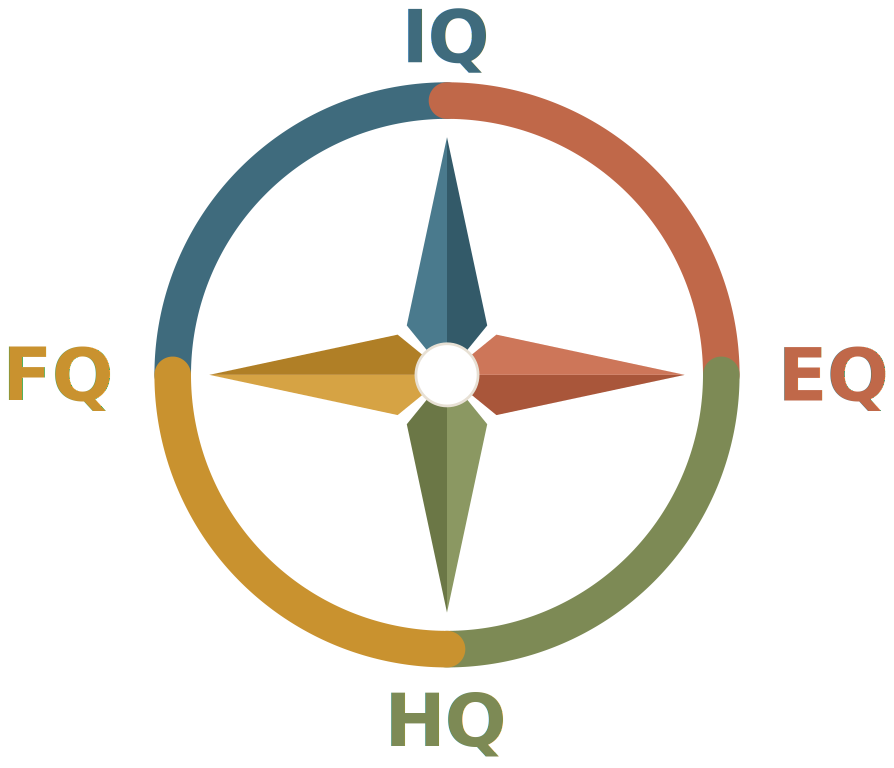
The 4Q Compass — a quiet daily journal.
A Personal Reflection Tool
The 4Q Compass — a quiet daily journal.
The 4Q Framework describes four essential dimensions of a balanced and fulfilling life.
This self-assessment helps you reflect on how intentionally you currently invest in each of these dimensions.
The goal is not perfection. Instead, this exercise creates awareness of where your energy is currently flowing and where it may be helpful to invest more attention.
Scores and notes stay in this browser on this device. Nothing is sent. There is no account, no form, and no average across the four intelligences.
For each statement below, rate yourself on a scale from 1 to 5.
1 = rarely true · 5 = consistently true
Three statements per intelligence. Sum the three. Each total runs from 3 to 15.
Learning, curiosity, and capability development.
Relationships, communication, and meaningful connection.
Physical vitality, recovery, and sustainable performance.
Financial discipline, security, and long-term independence.
Plot your four scores on the 4Q Compass.
This provides a snapshot of your current balance across the four intelligences.
Consider the following questions:
Which intelligence currently represents my strongest dimension?
Which dimension receives the least attention?
If I improved one dimension significantly over the next year, which would create the greatest positive impact in my life?
Use the ranges below to understand what each score suggests about your current investment in that intelligence.
| Score | Range | What it Suggests |
|---|---|---|
| 13–15 | Strong | This intelligence is well-developed and actively maintained. It may be a natural strength or the result of consistent investment. Consider whether it is crowding out attention to other dimensions. |
| 10–12 | Developing | Solid foundations exist, but uneven investment across the three pillars is likely. Identify which specific pillar is weakest and focus there first. |
| 6–9 | Emerging | This intelligence has not yet received the dedicated investment it needs. It is a likely source of friction or quiet anxiety in your life. Prioritize it in the next planning cycle. |
| 3–5 | Critical | This dimension is significantly underdeveloped relative to your other intelligences. It is likely limiting your effectiveness and wellbeing in ways that may not yet be fully visible. Treat it as urgent. |
The most useful insight from the 4Q Self-Assessment is rarely a single score — it is the pattern across all four. The following profiles describe the most common imbalance patterns observed in coaching practice. Read each and consider which resonates most.
High IQ and FQ — Lower EQ and HQ
Intellectually strong, financially disciplined, and professionally successful. But relationships feel transactional rather than nourishing, and the body is running on reserves. Energy is deployed as a resource to be managed, not a system to be maintained. The cost often becomes visible in midlife: capable and successful, but quietly unfulfilled.
The coaching focus: Rebuild emotional investment in relationships and physical vitality — not as a productivity strategy, but as an end in itself.
High EQ — Lower IQ, FQ, and sometimes HQ
Deeply relational, trusted by others, and emotionally present. But intellectual development has narrowed to the professional domain, financial planning has been deferred, and health is sustained by willpower rather than habit. Leadership is strong when things are going well; under pressure, the absence of strategic depth and financial security creates anxiety.
The coaching focus: Build the structural intelligence (IQ and FQ) that gives the relational strengths a durable foundation.
High across IQ, EQ, and FQ — Critical HQ
High-functioning in almost every domain, with health as the consistent casualty. Sleep, exercise, and recovery are the first things cut when pressure increases — and pressure is almost always increasing. The pattern is sustainable until it isn’t. Health crises, burnout, or a sudden loss of vitality often arrive as a surprise, despite all the evidence.
The coaching focus: Treat HQ not as a lifestyle choice but as infrastructure. Without it, the other three intelligences run on borrowed time.
Lower FQ — Stronger in other dimensions
Intellectually curious, emotionally intelligent, physically active — but financially underprepared relative to career stage. Often accompanied by avoidance: a vague sense that the financial picture is uncomfortable to look at clearly. The gap between earning and building is wider than it appears from the outside.
The coaching focus: Begin with awareness before strategy. A clear picture of the current financial position — without judgment — is the essential first step.
Relatively even scores across all four dimensions
Not necessarily high in every dimension, but consistently invested across all four. This is the goal state of the 4Q Framework: not perfection in any single intelligence, but ongoing awareness and deliberate investment across the whole. If your scores are even but lower than you would like, the work is about raising the floor — establishing minimum viable habits in each dimension that prevent any one from falling into neglect.
The coaching focus: Identify the one dimension most likely to slip under current pressures and protect it proactively.
The following questions are designed for use in a coaching session, or for deeper solo reflection. One question per dimension, chosen to open the conversation rather than close it.
“When was the last time you learned something that genuinely surprised you — and what did you do with that surprise?”
This question reveals the current state of intellectual curiosity: whether learning is active and energising, or passive and obligatory.
“Who in your life gives you the most honest feedback? And when did you last actively seek it?”
This question surfaces both the quality of the relational environment and the individual’s openness to candor — two different things that are easily confused.
“What does your body tell you on a Monday morning — and how often do you listen?”
The Monday morning signal is a reliable indicator of baseline vitality. The question also reveals the relationship between the individual and their own physical intelligence: attentive, avoidant, or somewhere in between.
“If your financial situation did not change at all over the next five years, how would that feel?”
The emotional response to this question — not the rational analysis — reveals the underlying relationship with financial security. Anxiety, relief, resignation, or clarity all point toward different coaching priorities.
Growth rarely comes from trying to change everything at once.
Based on your scores, your pattern profile, and your reflection, choose one dimension and one specific action for the next thirty days.
| Intelligence | Example Starting Action |
|---|---|
| IQ | Read one book outside your professional domain this month |
| EQ | Schedule one honest conversation you have been avoiding |
| HQ | Protect seven hours of sleep and a daily walk for thirty days |
| FQ | Create a clear picture of your current financial position — income, savings, investments, and debt |
The 4Q Compass app can support this commitment: log your chosen action, set a weekly check-in, and track your progress across all four dimensions as you build from one practice to four.
The Compass is on the App Store. Its daily scores use a different scale from this 1–5 assessment — they are not the same instrument.
Return to the 4Q Self-Assessment periodically — perhaps once or twice a year, or at moments of significant transition.
Life evolves, priorities shift, and different dimensions will require attention at different times.
The purpose of the 4Q Framework is not perfect balance, but ongoing awareness and intentional growth across the four intelligences that shape a fulfilling life.